Quinn Richter · 16 October 2026
Analyzing Retention Strategies Through Behavioral Patterns in Specialized Online Communities
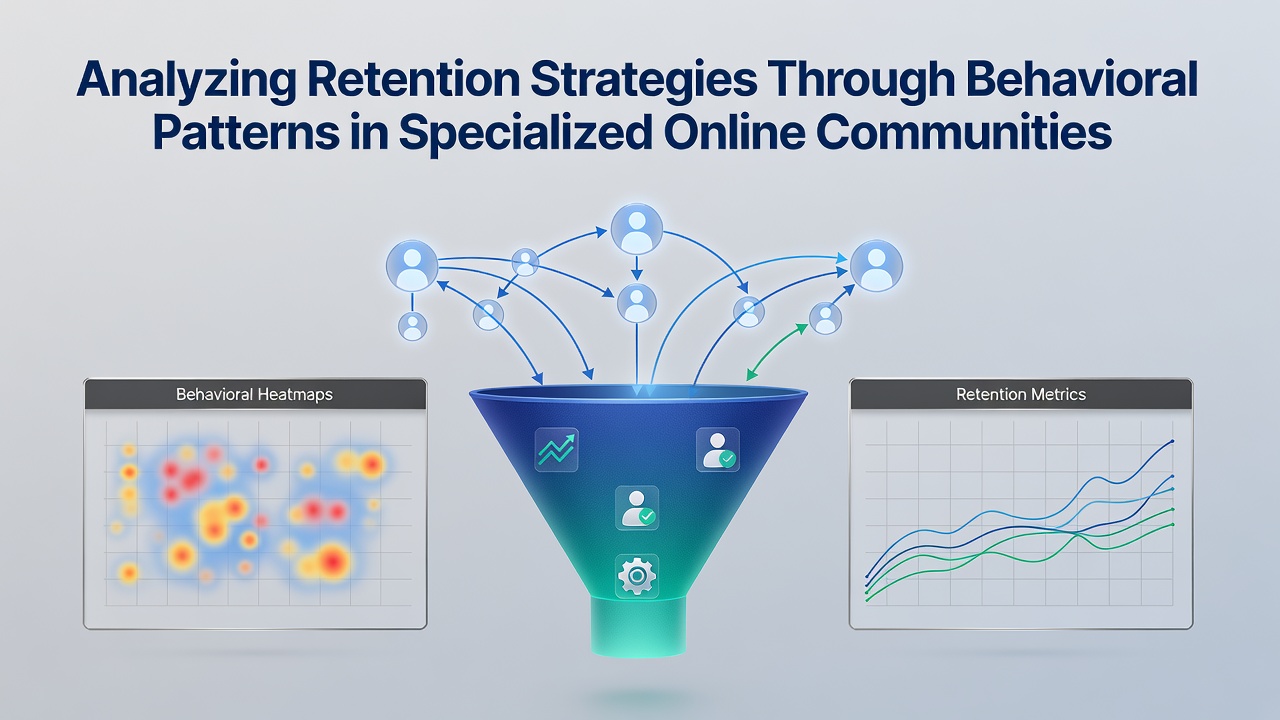
Specialized online communities ranging from professional forums to hobbyist discussion boards rely on behavioral data to shape retention approaches, and researchers track metrics such as login frequency, content contribution rates, and interaction depth to identify patterns that signal upcoming churn. Studies from multiple regions show that members who post at least once every seven days demonstrate higher long-term participation compared with those whose activity drops below that threshold, while session duration and reply chains offer additional signals that platforms monitor through automated systems.
Behavioral Indicators and Data Collection Practices
Observers note that platforms collect anonymized logs of click paths, dwell times on specific threads, and cross-posting activity across related groups, then apply clustering algorithms to segment users into cohorts based on these variables. Academic analyses from institutions in North America and Europe reveal that early indicators often appear within the first fourteen days of membership, including reduced profile updates or fewer responses to direct mentions. Government statistical agencies in Australia have documented similar trends in digital participation reports released through 2026, highlighting how seasonal fluctuations around October influence activity levels in educational and professional networks.
Those who study these environments point out that machine learning models trained on historical datasets can predict departure risks with increasing accuracy when they incorporate variables like time between visits and sentiment in text contributions. Data indicates that communities employing real-time dashboards achieve more timely interventions because they surface shifts in these patterns before they become permanent.
Strategy Implementation Across Different Community Types
Retention tactics built on behavioral insights take several forms, and operators adjust them according to the scale and focus of each group. In technical support forums, for instance, automated prompts that surface unanswered questions to active members increase reply rates, whereas hobbyist groups benefit from scheduled challenges that prompt members to share progress updates. Research indicates that personalized notifications tied to past contribution topics outperform generic reminders because they align with demonstrated interests rather than broad activity goals.

European regulatory bodies tracking digital services have recorded that communities providing transparent data summaries to members about their own activity patterns see measurable lifts in continued engagement. One approach involves milestone recognitions delivered at intervals calibrated to individual participation histories, and another uses peer-matching systems that connect users whose posting rhythms suggest complementary expertise. Figures from Canadian digital economy surveys released prior to October 2026 confirm that such targeted methods correlate with lower attrition across mid-sized professional networks.
Measurement Frameworks and Comparative Outcomes
Analysts evaluate retention performance through cohort survival curves that plot the percentage of members remaining active at successive time intervals after joining. These curves become more informative when segmented by entry channel, initial engagement depth, and demographic attributes, allowing operators to refine messaging and feature access accordingly. Reports compiled by research organizations across the Asia-Pacific region demonstrate that communities integrating behavioral triggers into onboarding sequences experience slower decay rates during the critical first month.
What's interesting is how cross-community comparisons reveal consistent thresholds, such as the point at which reply-to-post ratios drop below one-to-three, often preceding noticeable declines in logins. Platforms that test variations in notification timing against control groups document clearer cause-and-effect relationships, and those results feed iterative improvements to the underlying models.
Conclusion
Behavioral pattern analysis supplies specialized online communities with concrete inputs for retention planning, and ongoing data collection through late 2026 continues to refine the precision of predictive tools. Operators who maintain consistent tracking of interaction metrics while respecting privacy standards position their groups to respond promptly to emerging disengagement signals. The approaches described rely on verifiable activity logs rather than assumptions, and continued examination of these patterns supports more stable participation across diverse community formats.